



In Short
- White Card requirements: Construction work generally requires recognised induction. Visitor requirements depend on duties, access and supervision.
- Basic requirements: Complete approved training and assessment, meet the applicable age, identity and location requirements, and provide a USI unless an approved exemption applies.
- White Card requirements NSW, QLD and Victoria: While the course is nationally recognised, each state has its own workplace safety authority and slightly different rules around training delivery and card issuance.
- National recognition: Current, valid cards are generally recognised interstate. Inactivity-related retraining, site induction and task-specific requirements still apply.
Book your White Card with National White Card Courses
Ready to get started? Choose your state to find available classroom or online options, check the requirements and book your course with our team.
National Courses Pty Ltd · RTO 41072. WA courses are pending approval.
Need a hand choosing? Call 1300 988 181.
Understanding the White Card requirements is one of the first steps for anyone planning to work in Australia’s construction industry. This certification confirms you’ve completed essential safety training and understand the risks associated with working on construction sites.
But what exactly are the requirements, and how do they differ across states like New South Wales, Queensland and Victoria?
Whether you’re an apprentice, tradesperson, labourer, delivery driver or someone looking to start a new career in construction, understanding the requirements is essential.
In this guide, we’ll break down everything you need to know about what’s required to get a White Card in Australia, including eligibility, training, identification requirements and how the rules vary between states.
Quick White Card Facts
A White Card, formally known as a General Construction Induction Card, is proof that you have completed nationally recognised safety training for the construction industry.
This training covers basic construction safety. People carrying out construction work must meet the applicable induction and evidence requirements; visitor access rules depend on the jurisdiction and site.
The course that leads to a White Card is known as CPCWHS1001 – Prepare to work safely in the construction industry and it is delivered by registered training organisations such as NWCC.
The card demonstrates that you understand:
- Workplace health and safety laws
- Common construction hazards
- Risk control measures
- Site safety procedures
- Emergency response protocols
Employers and site managers must verify that construction workers meet the applicable induction and evidence requirements. A White Card does not replace site-specific induction, task training or separate licences.
Who Needs a White Card?
People carrying out construction work generally need a White Card. Some jurisdictions also cover workers routinely accessing operational construction zones. Roles that commonly involve these activities include:
- Builders and tradespeople
- Labourers and apprentices
- Site supervisors and project managers
- Surveyors and engineers
- Delivery drivers entering work zones
- Subcontractors
- People who regularly access operational construction zones
Check your activities, access and supervision arrangements. An escorted visitor or a person working outside a construction zone is not automatically subject to the same requirement as a construction worker.
Even some roles outside the traditional building trades may require a White Card if workers enter construction areas frequently.

Basic White Card Requirements in Australia
Although rules can vary slightly between states, the core requirements for a White Card are largely the same nationwide. To obtain a White Card, you must generally:
1. Complete Construction Induction Training
Complete an approved construction induction course covering CPCWHS1001. Our courses include knowledge, oral and written reporting, and practical assessment. You must demonstrate fitting eye protection, hearing protection, a hard hat and high-visibility clothing under assessor observation. Duration varies by jurisdiction, including a 4.5-hour minimum in Queensland and six hours in Victoria. Topics include:
- Construction safety legislation
- Hazard identification
- Risk management
- Personal protective equipment (PPE)
- Communication and safety signage
- Incident and emergency procedures
You can learn more about what’s covered in the course in our handy Learning Guide here.
After successful assessment, we issue the required training evidence and explain the card process. Interim evidence varies by jurisdiction; a Statement of Attainment is not a universal permission to work while waiting for a card.
2. Meet Age Requirements
Another key part of White Card requirements is the minimum age.
NSW and Tasmania expressly require a minimum age of 14. Other admission ages depend on the jurisdiction and our course policy. Contact us before enrolling a younger learner; a White Card does not override child-employment restrictions.
If you are under 18, training providers may require parental or guardian consent before you can complete the course.
Many school students complete their White Card as part of vocational education programs or while preparing to enter apprenticeships.
3. Provide Proof of Identity
Identity requirements depend on the issuing jurisdiction and the training or application stage. NSW normally requires original documents totalling 100 points, with special provisions for eligible school students, recent overseas arrivals and other specified applicants. Common standard-checklist examples include:
- Passport or birth certificate (70 points)
- Driver’s licence (40 points)
- Medicare card (25 points)
For Queensland, check the White Card identity checklist before booking. Category-based document combinations and verification conditions apply; contact us if you cannot supply the required combination rather than assuming one photo ID is enough.
Tasmania normally requires two category A documents, or one category A plus two category B documents. Service Tasmania has separate provisions for children aged 16 or under. A single driver licence or passport is not the standard adult application checklist.
Victoria requires photographic ID when registering and on the training day. SA, WA, NT and ACT have their own training or application checks. ACT online applications require identity verification through your own ACT Digital Account. Follow the relevant checklist for originals and any expressly accepted digital documents.

4. Obtain a Unique Student Identifier (USI)
A USI is normally required before we can issue your Statement of Attainment, unless an approved exemption applies. It gives you access to nationally recognised VET records reported from 2015 onwards. Arrange it before training where possible, or discuss your exemption or circumstances with us.
Creating a USI is free and usually takes only a few minutes online. You can create yours here.
5. Have Basic English and Literacy Skills
Participants must demonstrate basic English language, literacy and numeracy skills to complete the course and assessment.
This is necessary because students must:
- Understand safety instructions
- Read workplace signage
- Answer written or verbal assessment questions
Training providers may conduct a short language assessment before the course begins to ensure students have the language skills required.
State-by-state White Card Requirements
The training unit is national, but approval, delivery, learner-location, identity and card-application rules differ between jurisdictions. These relate to where and how you train and obtain the card, rather than simply where you later plan to work.
Below is a breakdown of the White Card requirements by state, including key information for workers planning to obtain certification in New South Wales, Queensland and Victoria.

White Card Requirements NSW
If you’re planning to work in New South Wales, understanding NSW White Card requirements is essential.
In NSW, the White Card is issued through SafeWork NSW after completing construction induction training.
Key requirements include:
- Minimum age of 14 years
- Completion of approved induction training with an RTO
- Proof of identity
- A verified USI unless an approved exemption applies
We submit the NSW card application to SafeWork NSW after successful completion. The training statement provides interim evidence for 60 days; most cards are issued within 30 days.
In NSW, a White Card becomes void after two consecutive years without construction work. This is a regulatory rule; required retraining is not merely an employer’s preference.
White Card Requirements QLD
The White Card requirements in QLD are very similar to the rest of Australia, although some details differ slightly.
In Queensland:
- Construction induction training must be completed through an approved RTO.
- Meet the identity requirements and provide a USI unless an approved exemption applies.
- The course assessment must be successfully completed before a card can be issued.
Our Queensland courses accept learners from age 13 under our enrolment policy. Confirm the current admission and consent requirements with us; this is not a claim that 13 is a national statutory minimum.
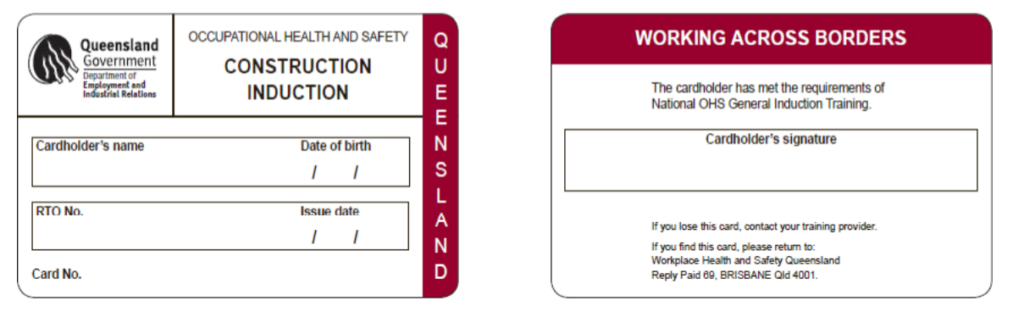
A current, valid Queensland White Card is generally recognised interstate. The approved RTO issues it. Approved live connected training is available through specifically authorised RTOs, with a minimum training duration of 4.5 hours.
White Card Requirements Victoria
When it comes to a White Card for Victoria, the main difference is how training must be delivered.
In Victoria:
- Construction induction training must be completed face-to-face in a classroom environment.
- Victorian-issued White Card training cannot be completed online. Valid interstate cards are a separate recognition question.
- The course must be delivered by an approved RTO recognised by WorkSafe Victoria.
The rest of the requirements are similar to other states:
- Proof of identity
- Completion of the training course
- Knowledge, communication and observed practical assessment
After successful training, the approved RTO applies to WorkSafe Victoria for your card. Training must take place in a physical classroom for at least six hours. A recent Statement of Attainment can provide interim evidence for 60 days.
Why White Card Training is Important
Construction remains one of Australia’s most high-risk industries, with workers frequently exposed to a range of potential hazards on active job sites.
These risks can include falling objects from above, operating around heavy machinery, exposure to electrical equipment, working at heights, and handling or working near hazardous materials.
Without the proper safety knowledge, these everyday site conditions can quickly become dangerous.
White Card training is designed to prepare workers for these realities by providing essential knowledge about identifying hazards, following safety procedures, and managing risks in a construction environment.
By completing this training, workers gain a clear understanding of how to protect themselves and others while on site. Ultimately, White Card certification plays an important role in promoting a safer construction industry, helping protect not only individual workers but also their colleagues, site visitors, and the wider community.

Choosing the Right White Card Course
When enrolling in a course, it’s important to choose a trusted and accredited training provider.
Look for organisations that:
- Are registered training organisations (RTOs)
- Provide nationally recognised training
- Deliver practical, hands-on safety education
- Are approved by relevant state safety authorities
Choose a provider and delivery method approved for the issuing jurisdiction. Current, valid cards are generally recognised interstate, but inactivity, site and task-specific requirements still apply.
Start Your Construction Career the Right Way
Understanding white card requirements is the first step toward entering Australia’s construction industry.
By completing the required safety training, you’ll gain the knowledge and awareness needed to work safely on building sites and meet legal workplace requirements.
Whether you’re an apprentice starting your career, a student exploring construction pathways, or a professional moving into the industry, obtaining your White Card is an essential milestone.
With the right training and certification, you’ll be ready to step onto site with confidence and contribute to a safer construction environment.
Applications in Tasmania, the NT and ACT
After training, Tasmania requires a separate Service Tasmania application, normally within 60 days, with the form, training evidence, ID and fee. A later application needs the specified RTO declaration. The NT also requires an application to Territory Business Centre within 60 days. For the ACT, apply to Access Canberra using your own ACT Digital Account and keep the application receipt together with your training certificate as interim evidence while it is assessed.
Frequently Asked Questions
Are White Cards valid across Australia?
Current, valid White Cards are generally recognised across Australia, so moving interstate does not normally require a new card. Check construction-work currency rules before returning after a long absence. Site induction, task-specific training and any required licences or work rights remain separate.
How long does it take to get a White Card?
Our training and assessment are normally scheduled within one day, with duration varying by jurisdiction. We issue training evidence after successful completion and required checks. Card administration and delivery are separate: some states use RTO-issued cards, while others require a government application. Interim evidence is accepted only under the relevant jurisdiction’s conditions.
What happens if you lose your White Card?
Use the issuing jurisdiction’s replacement process. Contact the issuing RTO for QLD, SA or WA, or the relevant government service for NSW, VIC, TAS, NT or ACT. Losing the card alone does not normally require retraining if your training is verifiable and current. A replacement does not restore lapsed validity, and a photo is not automatically accepted instead of the card.
What ID do you need to complete the White Card course?
Use the issuing jurisdiction’s current checklist and our enrolment instructions. NSW normally requires 100 points of original ID, with special provisions for eligible applicants. Queensland uses category-based verification, so confirm the required combination with us. Victoria requires photographic ID at registration and training.
For the Tasmanian card application, the standard adult requirement is two category A documents or one category A plus two category B documents. Separate provisions apply to children aged 16 or under. SA, WA, NT and ACT have their own checks; one photo ID is not a universal national rule. Only use digital documents where the relevant checklist expressly accepts them.
Do I need any prior experience to get a White Card?
No previous construction experience or trade qualification is required. Our course is designed to teach introductory construction safety. You still need to meet the age, identity and enrolment requirements and demonstrate the required knowledge, communication and practical skills. Contact us about language or learning support before booking.
Enrol in a White Card Course Near You

National White Card Courses is an accredited Registered Training Organisation (RTO 41072) providing nationally recognised White Card courses.
Our courses must meet the approval and assessment requirements for the issuing jurisdiction. Contact us before booking to confirm the delivery option, identity requirements and location conditions for your course.
We offer face-to-face training across Australia, including New South Wales, Queensland, Victoria, South Australia, Western Australia and Tasmania.
Our courses include trainer guidance and required knowledge and practical assessment. Approved live online training also requires real-time participation and assessor observation.
We help you prepare for the course and understand the required assessment. Before paying any provider, check its registration and course approval; our White Card scams guide explains what to look for.
After you pass, we issue your Statement of Attainment and explain the relevant card process. Valid, current White Cards are generally recognised interstate, subject to applicable currency and site requirements.