


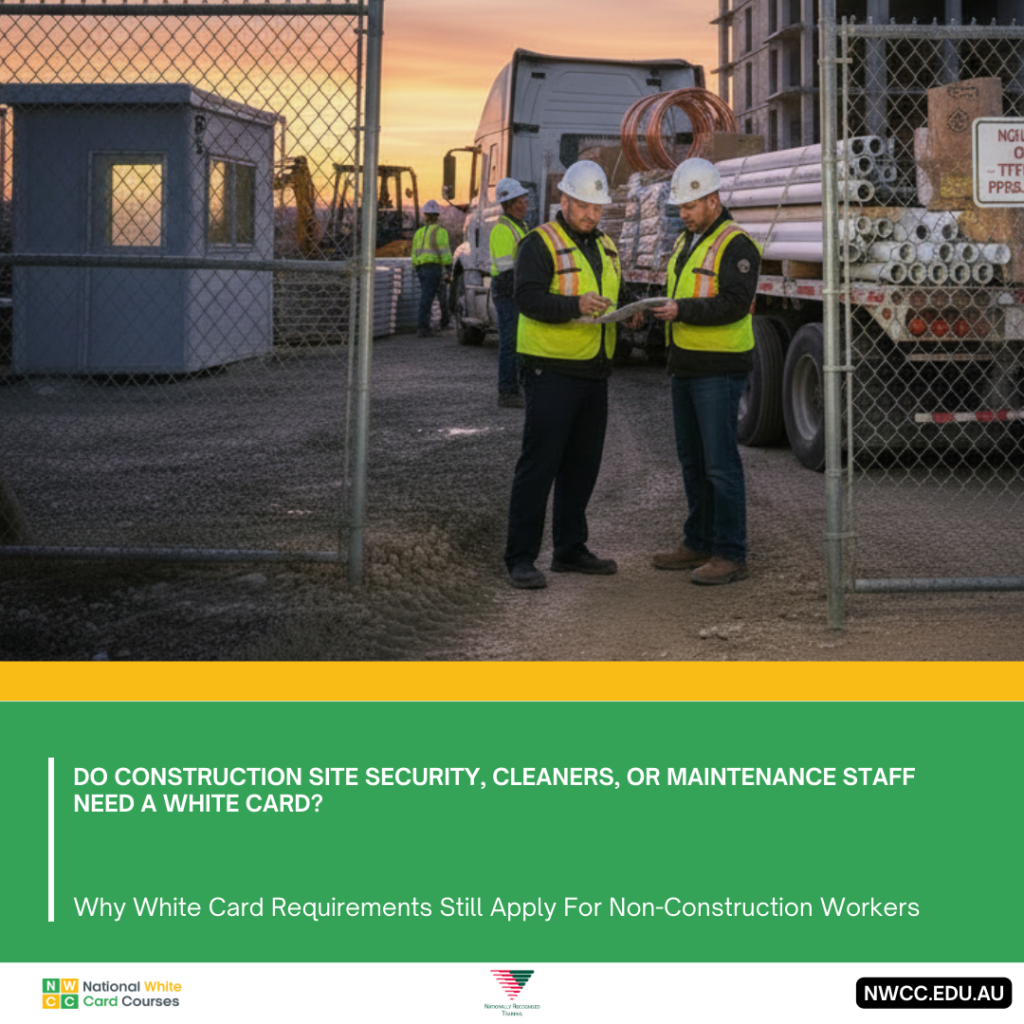
In Short
- Construction duties require a White Card, including relevant cleaning and maintenance work.
- Routine or unaccompanied access to operational construction zones may also require training.
- Separated offices, gatehouses and permitted escorted visits need a specific assessment.
- Minor maintenance exclusions depend on the task, not simply the age of the building.
- Site rules can add requirements but cannot waive the law.
- Cards have currency requirements, including rules about a two-year break from construction.
- Training delivery and identity checks vary by jurisdiction.
Book your White Card with National White Card Courses
Ready to get started? Choose your state to find available classroom or online options, check the requirements and book your course with our team.
National Courses Pty Ltd · RTO 41072. WA courses are pending approval.
Need a hand choosing? Call 1300 988 181.
Who Must Hold a White Card on an Active Construction Site
Security guards, cleaners and maintenance workers need a White Card when they perform construction work. Routine or unaccompanied access to operational construction zones can also require it. A separated office, designated delivery area or permitted supervised visit may be different.
The requirement to hold a White Card does not depend on job title.
Check the actual duties, operational-zone access and supervision against the relevant jurisdiction’s rules. Hazard exposure alone does not automatically establish a White Card requirement.
General construction induction is regulated by state and territory safety laws, including WHS laws and Victoria’s OHS framework.
It applies to construction work. Other people require an assessment of their role and access; not every person present on the property automatically needs a card.
This article explains when a White Card is required for security, cleaning, and maintenance roles, when it is not required, and what both workers and employers need to understand to remain compliant.
What Is a White Card?
A White Card is the nationally recognised certification that confirms a person has completed general construction induction training.
The current unit of competency is CPCWHS1001 – Prepare to work safely in the construction industry.
The purpose of the White Card is to ensure that anyone entering a construction site or high-risk work area understands:
- Common construction hazards
- Risk control measures
- Site safety procedures
- Their legal responsibilities under WHS law
White Card training is not trade-specific.
It is designed to provide baseline safety awareness for all people who may be exposed to construction environments.
Why White Card Requirements Apply For Non-Construction Workers
Many people assume that White Cards are only required for builders, labourers, and trades. This is incorrect, many roles need a White Card.
Construction workers need the required induction. People who routinely enter operational zones or need unaccompanied access may also require it under the relevant rules.
This includes roles that support site operations, even if construction is not their primary function.
Security personnel, cleaners, and maintenance staff often:
- Enter areas where construction work is underway
- Work near moving plant, equipment, or materials
- Are exposed to hazards such as uneven surfaces, noise, dust, or restricted access zones
For this reason, these roles commonly fall within the scope of White Card requirements.
When Is a White Card Legally Required?
A White Card is required when a person:
- Carries out construction work
- Is required to regularly enter construction zones as part of their duties
- Needs routine or unaccompanied access to operational construction zones, subject to local rules
The requirement applies regardless of whether the work is full-time, part-time, casual, or occasional. It also applies to contractors, subcontractors, and labour hire workers.
Employers and site controllers must verify required training and provide suitable induction, supervision and access controls. They cannot waive a legal White Card requirement.
Security Staff
Security staff patrolling operational construction zones will generally require a White Card. A guard confined to a separated gatehouse or reception area needs a role-specific check rather than an automatic assumption.
This commonly applies where security staff are responsible for:
- Patrolling construction areas
- Monitoring site access points
- Managing safety incidents or after-hours site security
- Overseeing equipment, materials, or temporary structures
Security staff working on live construction projects are considered to be operating within a construction environment and must understand site hazards and safety procedures.
When a White Card May Not Be Required for Security Staff
A White Card may not be required if security duties are strictly limited to:
- Completed buildings with no ongoing construction
- Office or commercial spaces fully separated from construction areas
- Locations where access to construction zones is not permitted
However, many principal contractors still require all onsite personnel to hold a White Card as a general site condition.
Cleaners
Cleaning construction areas or undertaking builders’ cleans as part of a project can require a White Card. Cleaning separated offices or amenities without operational-zone access may be excluded under local guidance.
This includes cleaners responsible for:
- Site amenities such as toilets and lunch areas
- Temporary buildings or structures within a construction zone
- Maintaining hygiene and safety in areas exposed to construction activities
Cleaners working on active sites are exposed to hazards such as plant movement, uneven surfaces, and construction materials. White Card training ensures they understand how to work safely in these environments.
When a White Card May Not Be Required for Cleaners
A White Card is generally not required where cleaning work is limited to:
- Routine cleaning of a completed, occupied building after construction and handover; a builders’ clean forming part of construction may still require a card
- Office spaces that are physically separated from construction activities
- Commercial buildings with no construction underway
If there is uncertainty, site rules or principal contractor requirements will usually determine access conditions.
Maintenance Staff
Maintenance that meets the legal definition of construction work requires a White Card. Minor testing, maintenance or repair can be excluded, but work on an existing building can still be construction work.
This applies to maintenance workers such as:
- Electricians (e.g. fault-finding or repairing existing wiring on-site)
- Plumbers (e.g. fixing leaks or maintaining existing pipework)
- HVAC technicians (e.g. servicing or repairing installed air-conditioning systems)
- Landscapers (e.g. planting, maintaining site drainage or erosion controls on active building sites)
- General repair and maintenance personnel (e.g. minor repairs or equipment servicing on site)
The duration of a task does not decide the issue. Check whether it is construction work or an excluded minor activity, and whether site access separately requires training.
When a White Card May Not Be Required for Maintenance Staff
A White Card may not be required where maintenance work is limited to:
- Completed buildings with no construction activity underway
- Routine servicing in operational facilities that are not construction sites
- Office, retail, or commercial spaces fully separated from construction areas
- Minor maintenance tasks performed entirely outside construction zones
Apply the regulator’s legal requirements first, then any additional site conditions. A contractor cannot override the law with an exemption of their own.
Employer Responsibilities and Legal Obligations
Employers, labour hire providers, and site controllers have legal responsibilities under WHS legislation.
These include:
- Verifying valid White Cards for workers whose duties or access require them
- Maintaining records of induction and training
- Preventing unqualified personnel from entering construction areas
- Ensuring contractors and subcontractors meet site safety requirements
Allowing a worker onto a construction site without the required induction can expose businesses to enforcement action, penalties, and liability if an incident occurs.
Quick Facts About the White Card for 2026
The following points are important for all workers and employers to understand:
Official course code for the White Card: CPCWHS1001 – Prepare to work safely in the construction industry.
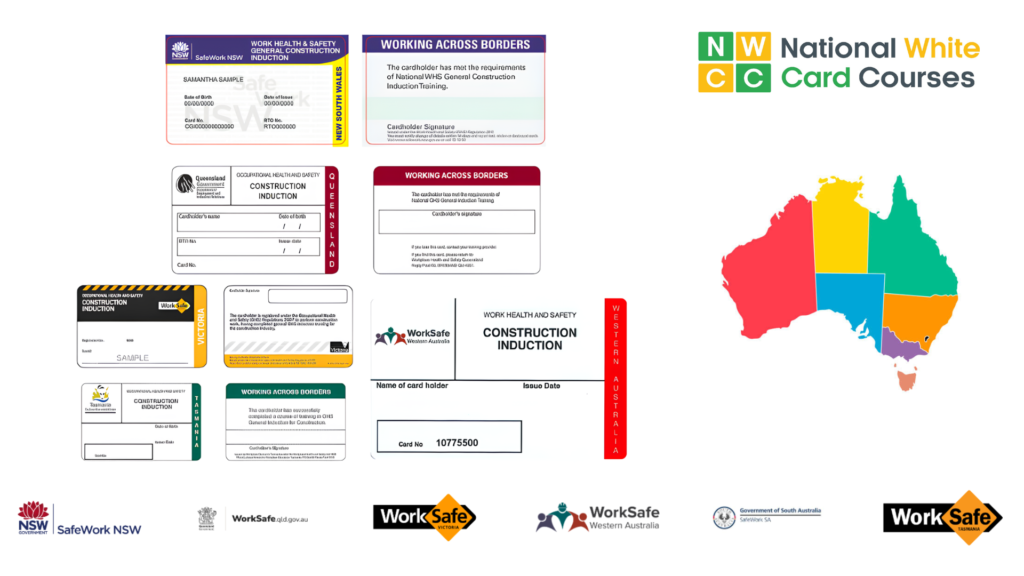
National recognition: Valid across all Australian states and territories.
Validity: There is usually no printed expiry date. Two consecutive years without construction work can invalidate a card or require retraining. Working in another high-risk industry does not automatically maintain construction currency.
Training method: Use an RTO approved for the jurisdiction and delivery method. Victoria requires classroom attendance; approved live connected options exist in Queensland and the Northern Territory. Practical PPE assessment is mandatory.
Identification: Evidence requirements vary by jurisdiction and can include special arrangements for younger learners or recent arrivals. A universal 100-point rule does not apply. Work rights are a separate employment requirement.
Unsure if You Need a White Card?
If unsure, give the site manager and regulator a clear description of the duties, work areas and supervision before booking or attending.
This avoids delays, access restrictions, and compliance issues.
Our courses include approved training and assessment, commonly scheduled in one day. Contact us to confirm available delivery options and group training for your location.
White Card for Site Security, Cleaners, or Maintenance Staff FAQ's
If my job is not construction, why would I still need a White Card?
Routine or unaccompanied access to operational construction zones may require a White Card, even where construction is not your main occupation. Check your duties, work areas, supervision and the local regulator’s rules.
Who decides whether a White Card is required: my employer or the worksite?
State or territory law sets the legal requirement. Employers must ensure required training, while site controllers can impose additional access conditions. Neither can waive a legal requirement.
Does working after hours or outside build times change the requirement?
No. Construction hazards often remain present outside standard working hours. If a site is still classified as an active construction workplace, a White Card is usually required even for after-hours security, cleaning, or maintenance work.
Can I rely on being escorted instead of holding a White Card?
Escorted access may be permitted for short, infrequent visits, but it is not guaranteed. Most sites do not allow escorted access as a substitute for obtaining a White Card, particularly for recurring visits.
Is a White Card still required if I am only performing minor or short-term tasks?
Short duration alone is not an exemption. Some minor testing, maintenance or repair is excluded from construction work, but the actual task and operational-zone access must be checked. Work on an existing building can still be construction work.
Is a White Card nationally recognised and valid in all states across Australia?
Yes. White Cards are nationally recognised and valid across all Australian states and territories.
Does the White Card expire?
There is usually no printed expiry date, but a two-year break from construction can invalidate a card or require retraining. Check the relevant regulator before returning after an extended absence. This can be a legal requirement, not simply employer policy.
Do delivery drivers entering a construction site need to hold a White Card?
Drivers making deliveries within operational construction zones may require a card. Delivery to a designated receiving area outside those zones may not. Confirm the route, unloading duties, supervision and local rules with the site manager.
Get Your Official White Card at a Training Location Near You!

When it comes to your safety and workplace credentials, don’t settle for less.
National White Card Courses is an accredited Registered Training Organisation (RTO 41072) providing nationally recognised White Card courses in Australia.
Our courses follow the approval and assessment requirements of the issuing jurisdiction. Contact us to confirm current delivery and location options.
Our courses include trainer guidance, knowledge assessment and observed practical PPE tasks.
Approved live online training includes real-time participation and assessor observation. Confirm approval before booking any course.
After successful assessment, we explain your training evidence and card process. Current, valid cards are generally recognised interstate, while site induction and task requirements remain separate.