Who Needs to Take the White Card Course?
In Australia, the White Card course is a mandatory requirement for anyone working in the construction industry, but it’s not just for builders and tradies.
If you’re planning to work on, or even enter, a construction site in Australia, you’ll need to complete the White Card course to ensure you understand Australian workplace health and safety (WHS) requirements. Here’s a breakdown of who needs to take the White Card course:
- On-site Workers – Including carpenters, plumbers, electricians, concreters, other skilled tradespeople,and site labourers.
- Management & Visitors – Including site managers, supervisors, architects, and engineers.
- Support Roles – Such as delivery drivers and, in some cases, administrative staff frequently entering active sites.
- Industry Entrants – Apprentices and trainees.
- International Workers – Backpackers or foreign workers on valid visas working in construction.
- Unaccompanied visitors – Anyone who accesses operational construction zones and is not directly supervised by an inducted person.
It’s important to note that the White Card isn’t just for the construction industry. It’s also required in other high-risk sectors in Australia, where safety is critical. This includes industries like:
- Mining: Workers in mining operations must adhere to strict safety standards, similar to those on construction sites.
- Manufacturing: Certain manufacturing jobs, especially those involving heavy machinery or hazardous materials, require similar safety training.
- Agriculture: Tasks like using machinery, handling chemicals, and working with animals can be dangerous without proper safety knowledge.
- Transport & Logistics: Drivers and warehouse staff involved in transporting goods, especially in high-risk conditions, need safety training.
- Landscaping & tree cutting: Because tree work often occurs within, or is considered part of, the construction and landscaping industry, a White Card is considered a mandatory requirement under WHS laws to ensure safety, particularly regarding site hazards.
In any high-risk industry, the White Card (or equivalent training) helps ensure workers know how to spot potential hazards, follow safety protocols, and react appropriately in emergencies.
How the White Card Course Runs
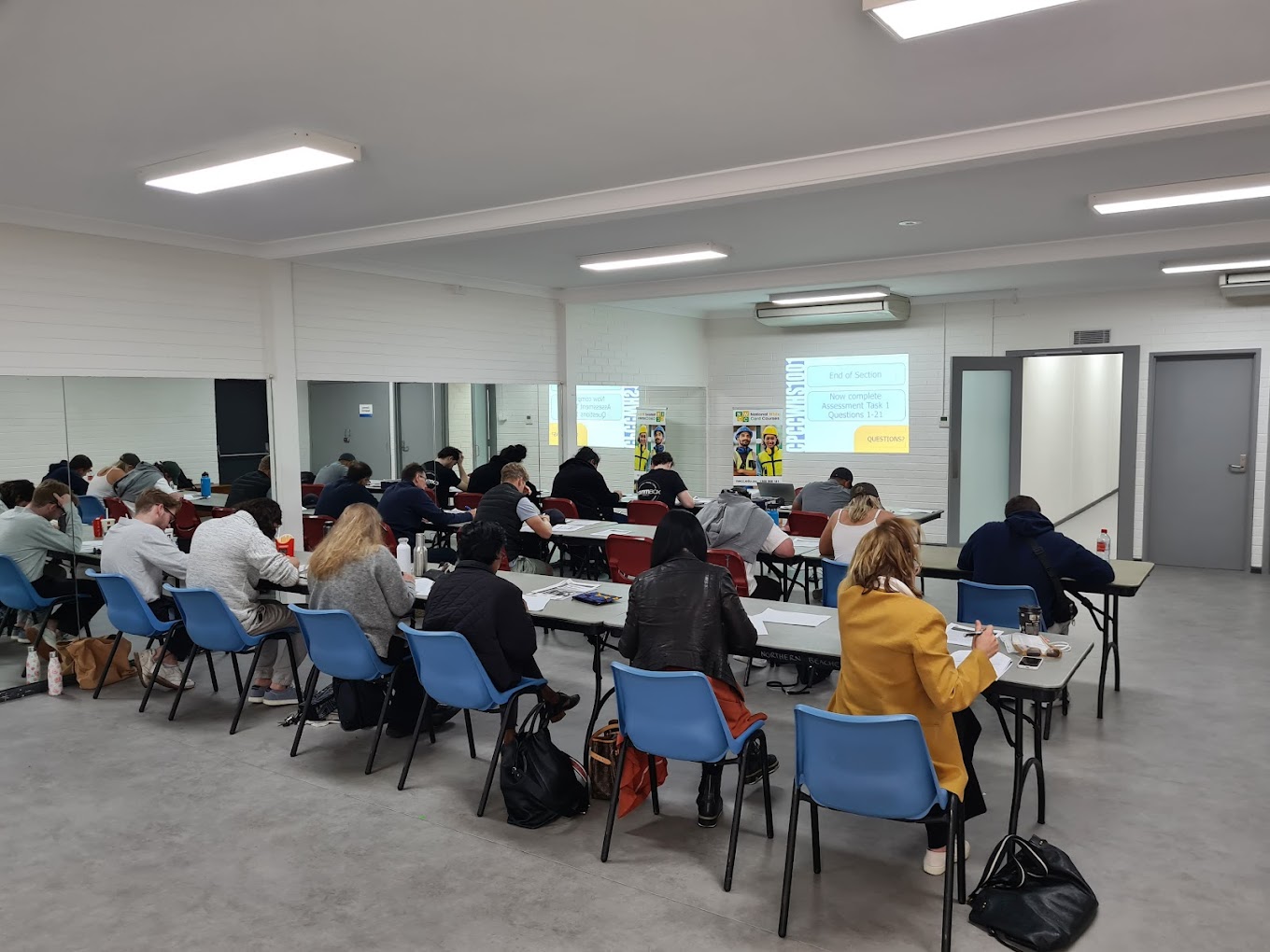
The White Card course is structured as a one-day training session, blending practical examples with theoretical learning. Here’s what to expect on the day of your White Card training and certification:
- Start: 9:00 AM
- Lunch Break: 11:30 AM (bring your own lunch unless otherwise stated)
- Finish: 2:00 PM
The course includes instructor-led presentations, group discussions, and real-world scenarios to make learning engaging.
What’s Covered in the White Card Course?
The White Card course is built around the national competency CPCWHS1001: Prepare to Work Safely in the Construction Industry. You’ll cover five key areas:
1. WHS Responsibilities
Both you and your employer have a legal responsibility to do everything reasonably practicable to protect others from harm in the workplace. The Workplace Health & Safety (WHS) Responsibilities component of the White Card course covers topics including:
- The employer’s responsibility to provide a safe workplace
- Worker obligations to follow safety procedures, report hazards and use personal protection equipment (PPE), and
- WHS law and how the legislation protects workers and the public from accidents and risk.
2. Identifying Hazards
Construction and job sites are considered high risk areas due to the hazards that are often commonplace within these environments. These hazards have the potential to cause immediate or long-term injury and even fatalities so must be recognised and carefully managed. Potential hazards include:
- Asbestos and silica dust: Invisible particles that can cause long-term health issues.
- Falling objects: Tools, debris, or materials can be deadly without proper controls.
- Electrical risks: Overhead powerlines, exposed wires, and damaged equipment.
- Unsafe manual handling: How to lift and move items safely.
3. Risk Management
Safely working on a job site isn’t just about recognising risks, it’s also about mitigating them. The White Card course covers a hierarchy of control measures that should be used to manage hazards and mitigate risk.
This hierarchy includes:
- Elimination: Remove the hazard completely.
- Substitution: Replace a high-risk activity with a safer one.
- Isolation: Restrict access to dangerous areas.
- Engineering Controls: Use equipment to reduce risks (e.g., barriers, ventilation).
- Administrative Controls: Training, signage, and policies.
- PPE: Your last line of defense, like hard hats and steel-capped boots.
4. Emergency Response
While the White Card course is designed to help people identify hazards and mitigate risks, in a busy or high-risk workplace environment, emergencies can happen. That makes preparation and response planning critical. The White Card course covers emergency response, including:
- Incident Response: Dealing with fires, structural collapses, or gas leaks.
- Evacuation Plans: How to exit safely and quickly.
- Emergency Equipment: How to use first aid kits, fire extinguishers, and locate emergency exits.
5. Understanding Workplace Signage
Safety signs are crucial for communication on construction sites. They help you understand potential dangers and risks, and also provide key information about activities that are happening in specific areas.
- Danger signs: Immediate life-threatening risks (e.g., “Live Wires”).
- Warning signs: Potential hazards (e.g., “Slippery Surface”).
- Mandatory signs: Actions required for safety (e.g., “Wear PPE”).
- Emergency signs: Directing to first aid stations, fire equipment, and exits.

What to Expect in the White Card Test
The White Card test ensures you’ve understood the key safety principles covered during the course. To help you feel prepared, here’s a breakdown of what’s involved in the White Card exam:
Test Format
The White Card test isn’t overly complicated, but it is designed to gauge your understanding of the topics covered in the course. To achieve this the test has different components, including:
- Multiple-choice questions: Assessing your understanding of WHS principles.
- Short-answer questions: Applying your knowledge to real-world scenarios.
- Practical assessments: Group discussions or activities to demonstrate understanding.
Topics Tested
The aim of the test is to determine your overall understanding of all the topics covered in the White Card course. That means there will be sections on each of the five main themes, including:
- WHS responsibilities for workers and employers
- Identifying and controlling hazards
- Interpreting workplace signage
- Emergency response procedures
- Correct use of PPE
Tips for Success
- Review the learning guide: Focus on WHS laws and hazard control principles to make the course easier to follow.
- Pay attention to real-world examples: Your course instructor will discuss a series of real world examples during training. These often show up in the test, so it’s a good idea to take note when practical scenarios are mentioned.
- Focus on the “why”: Much of the White Card training is about common sense. When you concentrate on understanding why WHS rules exist, it makes them easier to apply.
- Think practically: Completing the course is about considering how safety theory translates to the real world. During the training, it helps to apply the principles to real-world scenarios, rather than just memorising them.