
Key Takeaways
- These are the essential WHS and construction safety terms you’ll hear during your White Card course and on real Australian worksites.
- Understanding these definitions makes your training easier, helping you complete the course faster and with more confidence.
- This isn’t just classroom theory — these terms are used daily on-site, in documents, during toolbox talks, site inductions, and safety briefings.
- Knowing the language of site safety helps you stay compliant, communicate clearly with supervisors and workers, and reduce the risk of incidents on site.
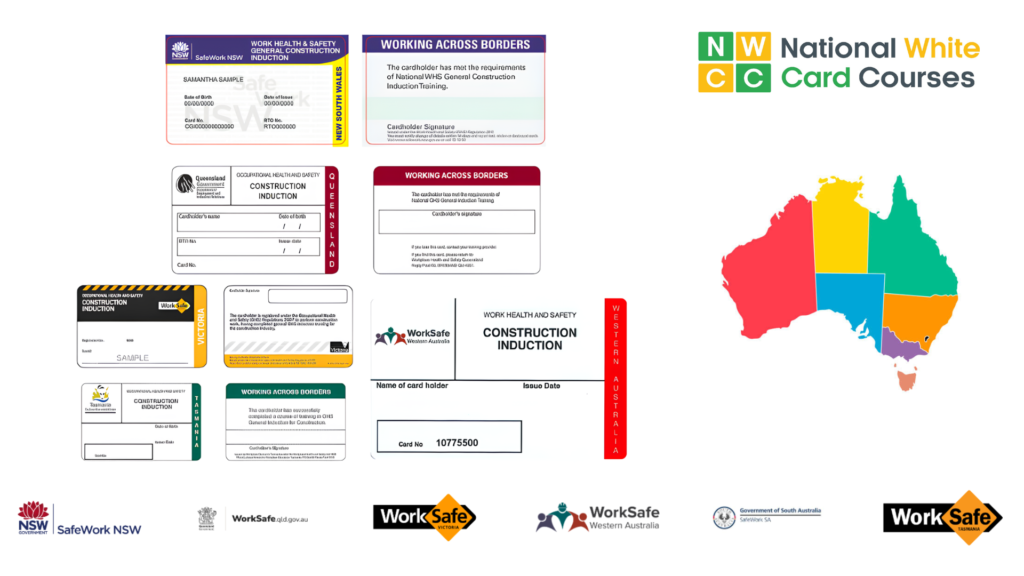
If you’re completing a White Card course with National White Card Courses, you’ll come across a lot of
construction and workplace safety terms — many of which you’ll hear again on real job sites.
This glossary explains the key words covered in the White Card course (CPCWHS1001) in plain English,
so you understand what they mean, why they matter, and how they’re used in real construction environments across Australia.
Whether you’re new to construction or just want a clearer understanding of the language used during white card training,
this guide covers the essential terms you’re expected to know before stepping onto site.
Quick Reference Table of Terms (Click to View)
Core WHS Concepts
- Work Health and Safety (WHS)
- Hazard
- Risk
- Risk Assessment
- Control Measure
- Hierarchy of Control
- Duty of Care
Roles & Responsibilities
- Person Conducting a Business or Undertaking (PCBU)
- Principal Contractor
- Foreman
- Supervisor
- Site Manager
- Worker
- Health and Safety Representative (HSR)
- Safety Officer / WHS Officer
Site Rules & Documents
- Site Induction
- Safe Work Method Statement (SWMS)
- Job Safety Analysis (JSA)
- Safety Data Sheet (SDS)
- Permit to Work
- Traffic Management Plan (TMP)
- Toolbox Talk
PPE & Safety Equipment
- Personal Protective Equipment (PPE)
- High-Visibility Clothing (Hi-Vis)
- Hard Hat
- Safety Footwear
- Eye Protection
- Hearing Protection
- Respiratory Protective Equipment (RPE)
Hazards & Risk Types
- Physical Hazard
- Chemical Hazard
- Biological Hazard
- Manual Handling
- Working at Heights
- Confined Space
- Silica Dust
Incidents, Emergencies & Reporting
Core WHS Concepts – Definitions
Work Health and Safety (WHS)
The legal framework and practical measures designed to protect workers’ health, safety, and wellbeing on Australian worksites,
covering everything from training to hazard management.
Hazard
Anything on a construction site that could cause harm, from moving machinery and falling objects to electrical hazards
and extreme weather conditions.
Risk
The chance that a hazard will cause injury or illness, factoring in both likelihood and severity.
Risk Assessment
The process of spotting hazards, evaluating the potential danger, and deciding how best to manage or remove the risk.
Control Measure
Practical steps or equipment used to reduce or eliminate risks, like guardrails, signage, or PPE.
Hierarchy of Control
A systematic approach to safety: eliminate the hazard first, then substitute, isolate, engineer controls, apply administrative
procedures, and lastly use PPE.
Duty of Care
The legal and moral responsibility of everyone on site to ensure their own safety and the safety of others.
Roles & Responsibilities – Definitions
Person Conducting a Business or Undertaking (PCBU)
The entity legally responsible for ensuring a safe work environment, providing training, systems, and supervision
on Australian construction sites.
Principal Contractor
The main contractor in charge of a construction project, coordinating trades, safety procedures, and high-risk work compliance.
Foreman
On-site leader who assigns tasks, supervises workers, enforces safety rules, and communicates daily operational instructions.
Supervisor
Oversees specific work crews or trades, monitors safety compliance, and ensures tasks are completed correctly.
Site Manager
Manages overall site operations, including scheduling, resource allocation, and WHS compliance across all trades.
Worker
Any person performing work on site, including employees, subcontractors, apprentices, and labour hire staff, responsible for
following safety procedures and reporting hazards.
Health and Safety Representative (HSR)
Worker-elected representative who monitors workplace safety, raises concerns, and liaises with management.
Safety Officer / WHS Officer
Specialist responsible for monitoring compliance, inspecting sites, reviewing SWMS, and assisting in investigations.
Site Rules & Documents – Definitions
Site Induction
Orientation that introduces workers to site hazards, rules, emergency procedures, and expectations.
Safe Work Method Statement (SWMS)
Detailed plan for high-risk work, outlining hazards and step-by-step controls.
Job Safety Analysis (JSA)
Task breakdown used to identify hazards and apply safety measures before work starts.
Safety Data Sheet (SDS)
Information sheet providing hazard details, handling instructions, and emergency procedures for chemicals.
Permit to Work
Written authorisation for specific high-risk tasks, ensuring safety controls are in place.
Traffic Management Plan (TMP)
Plan to safely control vehicle and pedestrian movement around the worksite.
Toolbox Talk
Short, practical briefing on safety topics, given to workers before or during work.
PPE & Safety Equipment – Definitions
Personal Protective Equipment (PPE)
Equipment or clothing designed to protect workers from site hazards, such as helmets, gloves, or eye protection.
High-Visibility Clothing (Hi-Vis)
Bright clothing to ensure workers are seen by others, especially near moving vehicles or machinery.
Hard Hat
Protective helmet designed to prevent head injuries from falls, debris, or collisions.
Safety Footwear
Boots with protective features like steel caps or slip-resistant soles to prevent foot injuries.
Eye Protection
Goggles or glasses that shield eyes from dust, flying particles, or chemical splashes.
Hearing Protection
Earplugs or earmuffs that prevent hearing damage in noisy environments.
Respiratory Protective Equipment (RPE)
Masks or respirators that protect from inhaling dust, fumes, or hazardous chemicals.
Hazards & Risk Types – Definitions
Physical Hazard
Any site condition that could cause physical harm, such as falling objects, trips, or moving machinery.
Chemical Hazard
Exposure to dangerous substances like solvents, fuels, adhesives, or cleaning agents.
Biological Hazard
Hazards from bacteria, viruses, mould, or human/animal bodily fluids.
Manual Handling
Tasks that involve lifting, pushing, or carrying objects that may cause musculoskeletal injuries.
Working at Heights
Any task performed where a fall could occur, such as scaffolding or ladders.
Confined Space
Enclosed or partially enclosed areas with limited access that may contain hazards like low oxygen or toxic gases.
Silica Dust
Fine dust generated during cutting, grinding, or drilling concrete, stone, or tiles; can cause lung disease if inhaled.
Incidents, Emergencies & Reporting – Definitions
Incident
Any unplanned event on site that causes or could cause harm.
Near Miss
An event that had the potential to cause harm but was avoided or did not result in injury.
Notifiable Incident
A serious incident that must be reported to the regulator, such as a fatality, serious injury, or dangerous occurrence.
First Aid
Immediate medical assistance given to an injured or ill person on site.
Emergency Procedures
Predefined steps to respond to fires, spills, medical emergencies, or other site hazards.
Evacuation
Safe removal of personnel from a hazardous area or the entire site during an emergency.
Need to Book a White Card Course?
Knowing construction safety terms is one thing — actually remembering them and using them on site is another.
Our White Card courses are designed for both first-time construction workers and those needing a refresher update.
We don’t just hand you a booklet of terms — our experienced trainers bring every concept to life with real-world examples,
hands-on exercises, and interactive learning.
You’ll quickly understand how to:
- Spot hazards before they become incidents
- Choose the right control measures, not just rely on PPE
- Communicate clearly with supervisors, foremen, and safety officers
- Apply WHS laws and site procedures confidently every day
Our experienced trainers understand exactly what new workers need to know to stay safe, confident, and compliant on-site.
They break down complex safety rules into practical, easy-to-remember lessons that stick long after your course ends.
Your White Card Made Easy
Getting your White Card with NWCC is simple. We offer nationally recognised White Card courses at multiple locations around Australia.
You’ll receive your official Statement of Attainment, often on the same day, so you can start working as soon as possible.
Whether you’re booking as an individual or as a group, we make the process quick and straightforward.
Book your White Card course today and take the first step toward a safe, confident, and rewarding construction career.
Get Your Official White Card at a Training Location Near You!

When it comes to your safety and workplace credentials, don’t settle for less.
National White Card Courses is an accredited Registered Training Organisation (RTO 41072) providing nationally recognised White Card courses in Australia.
Our White Card training and certification is approved by all relevant government bodies, including SafeWork NSW, WorkSafe QLD, WorkSafe VIC, WorkSafe WA, SafeWork SA, and WorkSafe Tasmania.
We ensure you receive comprehensive, hands-on instruction that online courses simply can’t match.
By choosing National White Card Courses, you’re protecting yourself from the risks associated with online training — like potential scams, unrecognised certifications, and inadequate preparation for real-world scenarios.
Our White Card training provides you with a legitimate and valid White Card certificate that can be used anywhere in Australia.
Enrol in a Government-Approved White Card Course Below: